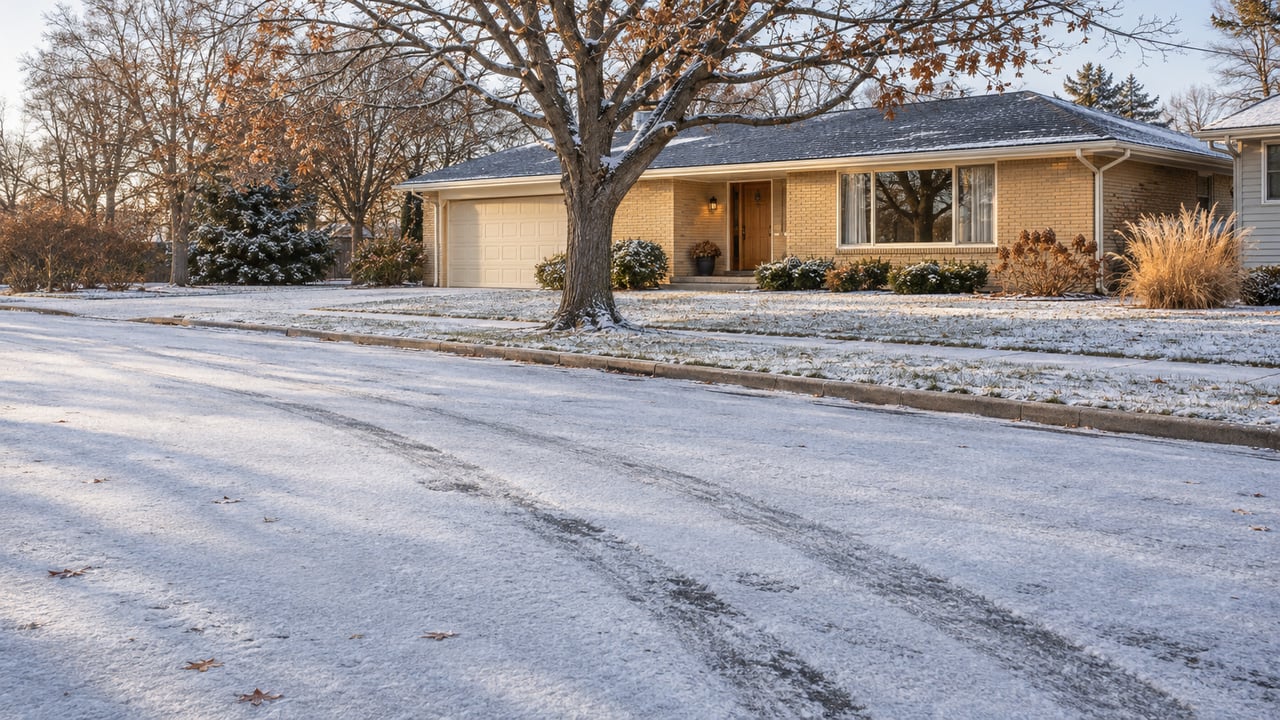
When snow falls on Grand Island, what decides when a plow turns onto your block? The city's written procedure sets an order of work and a minimum snow depth, and those two rules explain most of what happens outside your window after a storm.
The order works like a queue. Main roads go first, and they go again if the snow keeps falling. City crews usually reach neighborhood streets only after the main roads are done, and those streets also wait for the snow to get deep enough. So a light dusting, or a storm that drags on all day, can mean a long wait on a residential street, even while the arterial a few blocks over looks freshly cleared.
The order is written down
The city's Snow Removal and Ice Control Policy and Procedure for 2025–2026 puts every street into one of four groups and works through them in this order:
- Snow emergency routes
- Residential streets and school routes
- Downtown clearing and hauling, done at night
- Everything else, such as widening main roads and clearing low-traffic areas
Ice control comes before any of that. Overpasses and underpasses ice up before ordinary pavement, so they get treated first, and the emergency routes may be treated as part of the same run.
The rule that matters most for a neighborhood street is how the emergency routes are handled during a storm. The procedure says those routes are plowed before any other street is started. If heavy snow is still falling after the first round, the routes get plowed again, "and so on until the storm subsides." After that, city crews can move on to residential streets when the Street Supervisor gives the go-ahead. There is one exception. When outside contractors or other agencies, such as Hall County, are brought in to help in residential areas, they may start on those streets before the emergency routes are finished, so they stay out of the way of the city's crews. A long, steady snowfall keeps the trucks on the arterials longer, and that is why side streets can sit untouched well into a storm.
Two inches for the routes, three for your block
The second rule is about depth. As general guidance, the plan starts plowing snow emergency routes once 2 inches have fallen within 24 hours. Residential and local streets are plowed at 3 inches within the same window. In the city's usual operation, residential plowing also waits until the emergency-route work is finished.
The equipment differs too, and you can see it from the curb.
| Snow emergency routes | Residential streets | |
|---|---|---|
| Starting depth, general guidance | 2 inches in 24 hours | 3 inches in 24 hours, usually after routes are done |
| Equipment | Tandem plowing with two to three units | Typically one unit per residential area |
| Goal after snowfall stops | Open within 4 hours | Substantially plowed within 16 hours |
Both time goals start counting when the snow stops falling. Put the depth rule and the start time together and you get the usual winter pattern in Grand Island. On the routes, the trucks run in tandem so they can clear the whole street quickly and bury less of the sidewalk. If one truck gets stuck, another is right there. In a neighborhood, one truck runs about six to twelve inches from the curb at roughly 15 mph. The plan stresses clearing all the way to the curb line so storm drains stay open, cars have room to park and mail carriers can reach mailboxes from their vehicles.
A field checker then goes back through residential areas to report any streets or cul-de-sacs that still need work.
Staffing affects all of this. The plan says the Streets Division's staffing is limited, so other city departments fill the plow seats during an event. The Wastewater Division provides at least three people, and Utilities sends staff as needed.
Downtown and alleys come last
Downtown is Priority 3, cleared after the residential areas and done overnight, when traffic is lightest. The hauled snow goes to the city's snow pad at 2930 E. Bismark Rd. If more room is needed, the parking lots at L.E. Ray Park, Ryder Park or Ashley Park can be used. The goal is to have downtown hauled out within 48 hours after the snow stops.
Alleys may be plowed or hauled only after all other hauling is finished. Crews take into account whether residents have already cleared them and whether obstacles or utilities could make the work risky.
Which list your street is on
Because the whole system runs on that first priority group, the list of snow emergency routes decides a lot. It sets which streets get cleared first, and it also sets where parking is banned during a declared emergency.
The City Council rewrote that list this summer. On July 28, 2026, it passed Ordinance No. 10,083, which replaced City Code Section 22-113. According to the council minutes, Public Works Director Keith Kurz said the list needed updating because the new U.S. Highway 30 alignment led to Old Highway 30 being renamed and lengthened. The council suspended the rules and approved the ordinance the same night. All nine members present voted yes.
The new list includes Old Highway 30 from Husker Highway to Old Potash Highway, along with U.S. 30, U.S. 34 and U.S. 281 within city limits. It also names familiar cross-town streets such as Locust Street from Interstate 80 to First Street, Capital Avenue from Engleman Road to Shady Bend Road, Faidley Avenue from Redwood Road to Broadwell Avenue, and Fonner Park Road from Adams Street to Stuhr Road. Stolley Park Road from U.S. 30 to Stuhr Road is on the list as well.
Stolley Park Road is still a construction zone heading into winter. KSNB reported in September that the stretch west of Stuhr Road had closed for about 1,200 feet, with a detour on South Locust Street, Fonner Park Road and Stuhr Road, and that the project was expected to be finished Dec. 15. Fonner Park Road, the main detour, is on the emergency route list too.
The city's snow emergency route map is linked from its Snow Emergency Hub. On the street itself, routes are marked with red, white and blue snow emergency signs. The city document listing shows the map file dated Nov. 10, 2025, which is before the July change. The ordinance text is the current list of record.
Some routes inside the city are plowed by Hall County instead of the city. A 2017 interlocal agreement, amended in 2020, splits the work, and the hub links a map of city and county responsibilities. For conditions on U.S. 30, U.S. 34 and U.S. 281, Nebraska 511 has a Plow Tracker layer under Winter Driving.
Parking follows the same lists
Each list comes with its own parking rule:
- Snow emergency routes. When the mayor or a designee declares a snow alert or emergency, parking is banned on every route for as long as the declaration is in effect. Grand Island police check the routes from the start to the end of the emergency. A car that is ticketed, still not moved and still in the way of plowing can be towed.
- Residential streets. A snow emergency does not automatically limit parking on a neighborhood street. If it applies to local streets, the mayor's declaration names the side or area and the time it starts.
- Downtown. City Code Section 22-112 bans parking from midnight to 8 a.m., Oct. 15 through April 15, on 16 listed downtown street segments, whether or not it snows. That rule is already in effect this season.
- Stalled vehicles. If a car stalls on an emergency route during a parking ban, it has to be pushed or towed to the nearest cross street that isn't a route, or to another suitable spot. Leaving it is allowed only briefly, while getting help.
The city announces snow emergencies through local radio and TV, the newspaper, the city website, Facebook and X. The hub lists (308) 385-5322 for questions during an active emergency.
The part that lands on your side of the curb
The single plow on a residential street pushes snow toward the curb, which means onto sidewalks and into driveway openings. The city's guidance takes that into account:
- Wait for the plow before finishing the driveway, so you aren't shoveling the end of it twice. The hub links a driveway clearing diagram.
- Don't blow, shovel or plow snow into the street. The city says that violates City Code.
- Clear enough room around the mailbox for drive-up delivery.
- Clear snow so fire hydrants stay visible and easy to reach.
This is general information, not legal advice. For questions about how a city rule applies to your property, check the City Code or call the city.
Our Grand Island team keeps track of this kind of local detail every winter, whether you're settling into a new street or getting a home ready to list before spring. If you'd like a hand, the team at Summit Real Estate is always glad to talk it through. Contact Us Today.