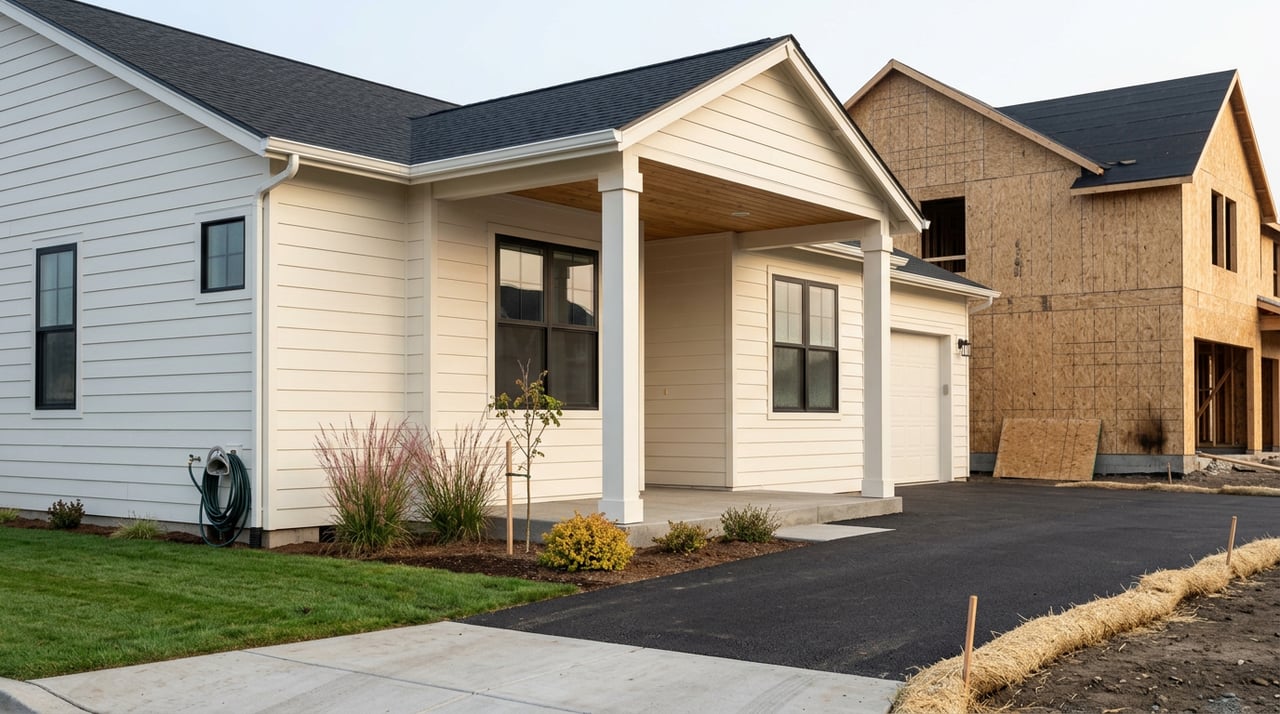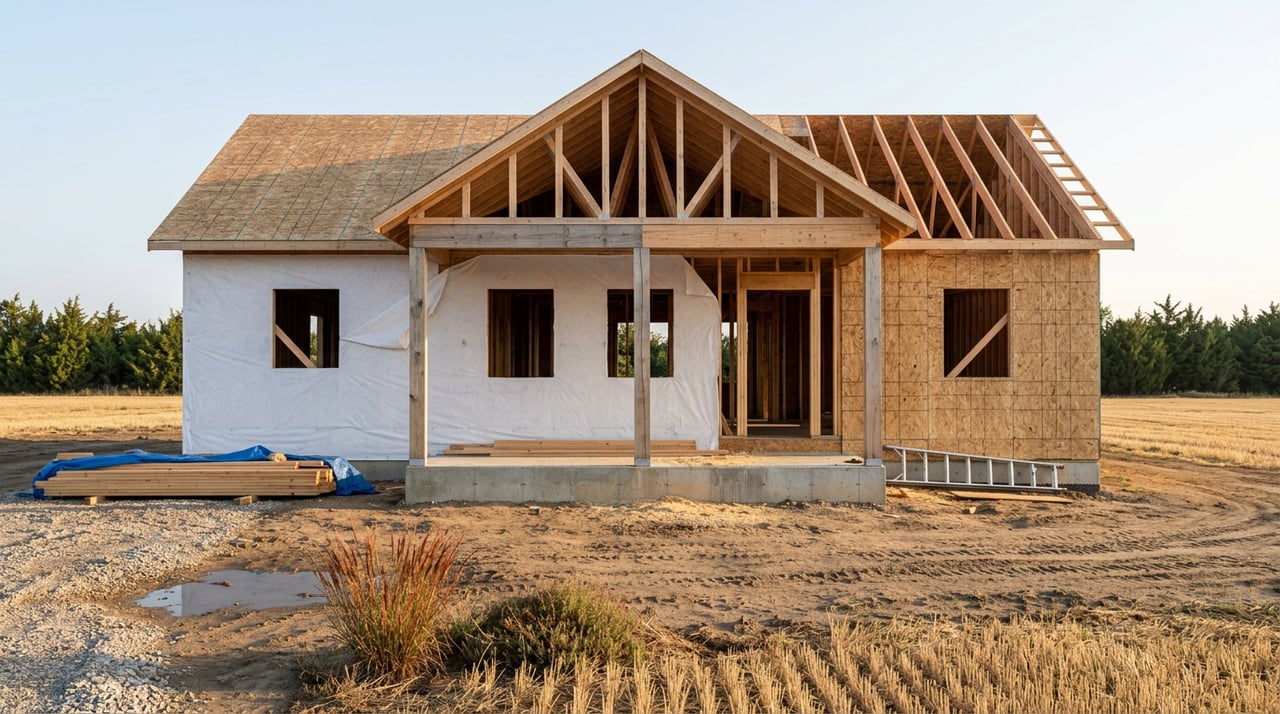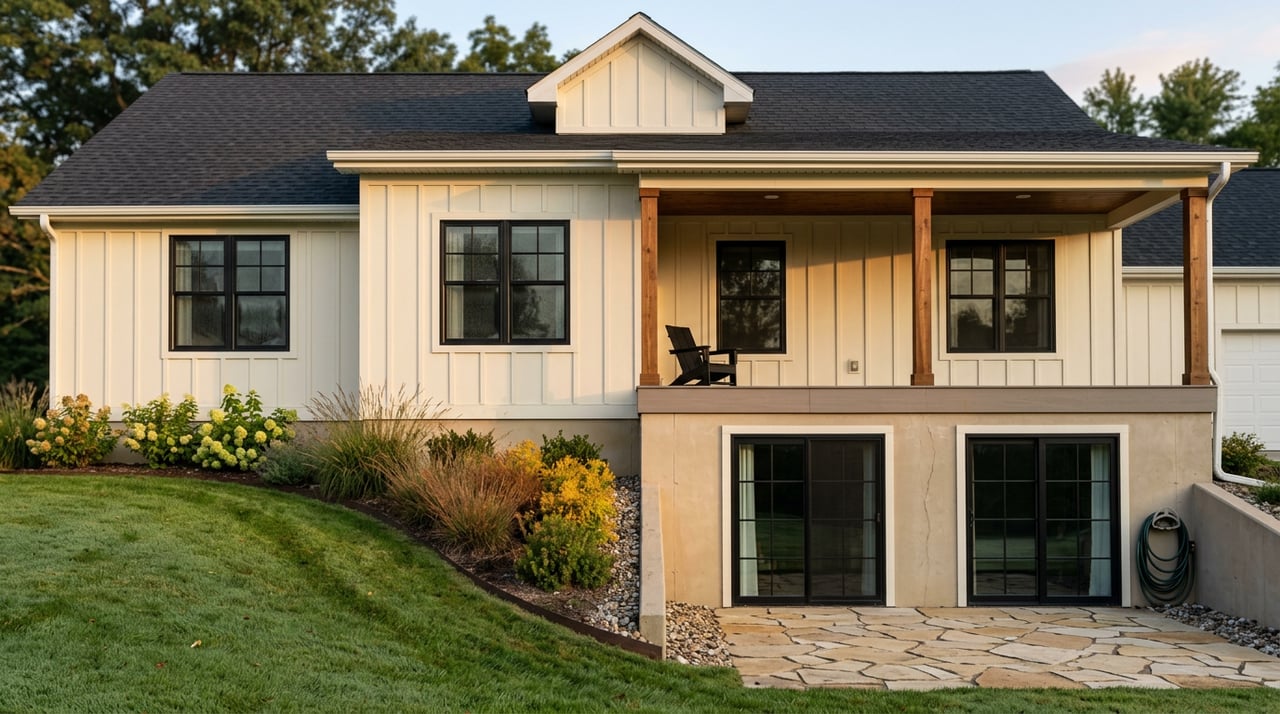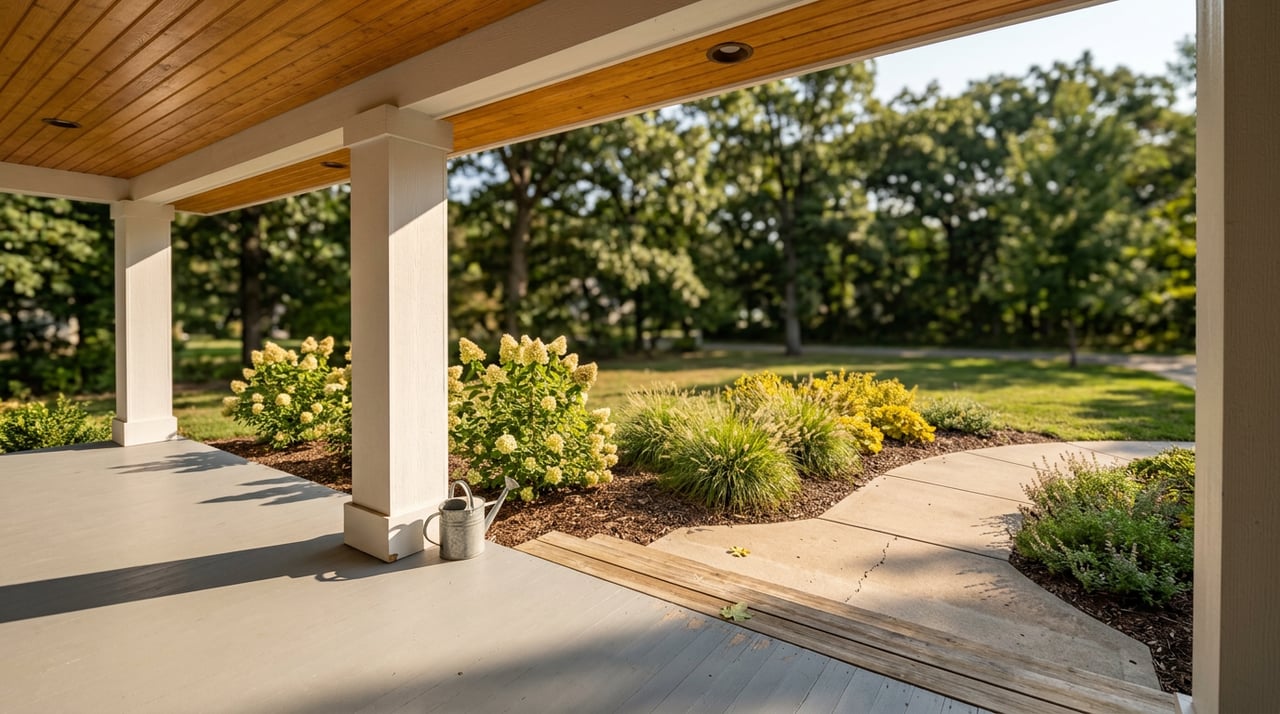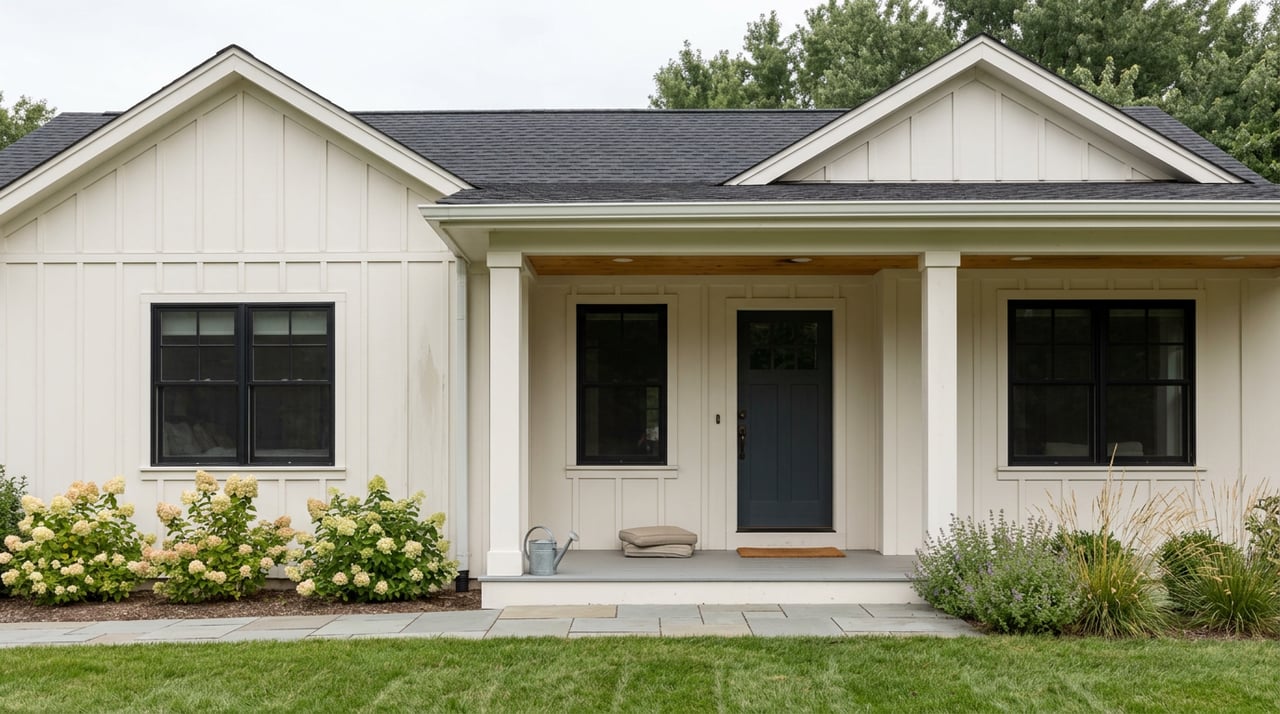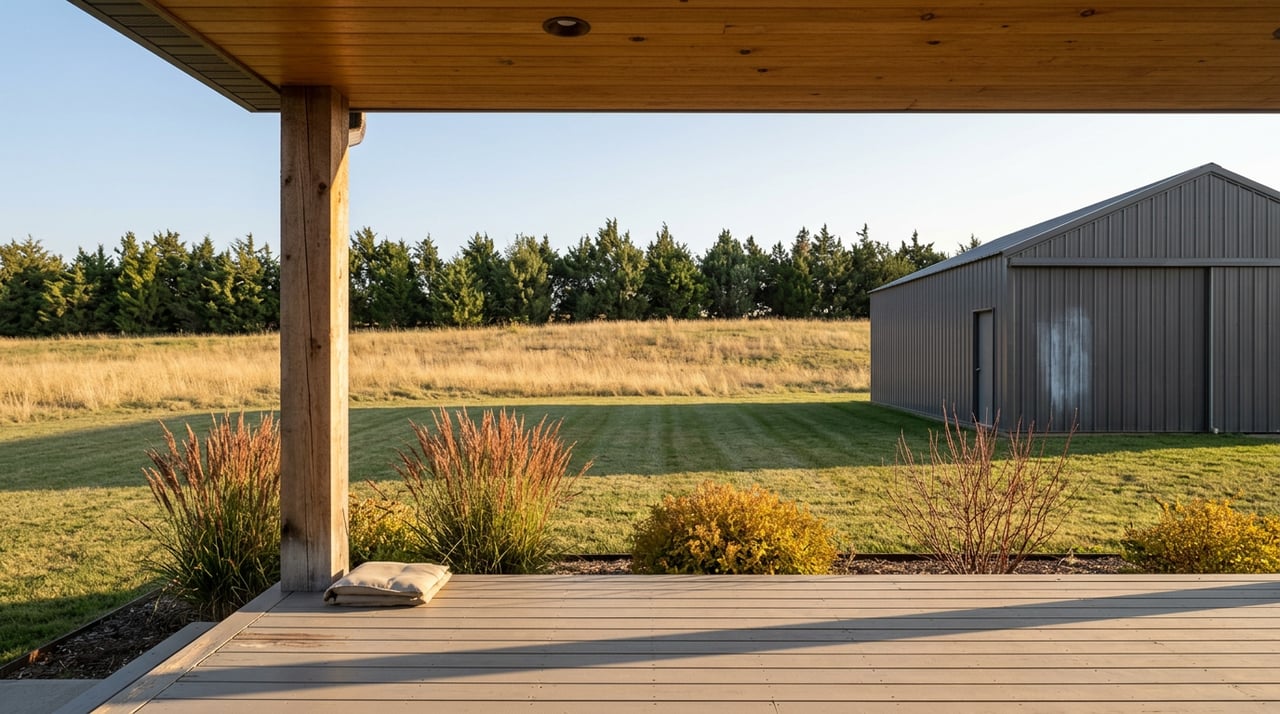
A buyer picks a lot on Eagle Ridge, ten acres of gentle roll northwest of Kearney, and starts sketching a barndominium with a walkout basement tucked into the slope. The covenants allow it. Outbuildings are fine too. Then that buyer calls a lender to lock in an FHA, VA, or USDA one-time-close construction loan, and the answer changes.
That's the gap nobody flags early enough. Eagle Ridge's rules and your loan program's rules are two separate conversations, decided by two separate parties, and they don't always agree.
The Land Seller Isn't Your Lender
Eagle Ridge sits northwest of Kearney, within about 15 minutes of town, on rolling hills and deep valleys that lend themselves to walkout basements. Lots run a 10-acre minimum, sized and located to the buyer's preference, and the development's own terms allow barndominiums and outbuildings. Buyers are responsible for bringing their own driveway and electrical service to the lot, and every parcel is sold subject to a final survey completed before closing.
None of that touches financing. A covenant tells you what you're allowed to build. It says nothing about what a specific loan program will fund. Those are decided at the federal level, by investor guidelines written for the loan product, not by the land's own rules.
What the One-Time-Close Fine Print Actually Excludes
FHA, VA, and USDA one-time-close construction loans bundle your construction financing and your permanent mortgage into a single closing. It's a popular structure for exactly the kind of build Eagle Ridge invites, since you're not just buying a finished house, you're financing one from the ground up.
The catch: investor guidelines for these three one-time-close programs only cover single-family dwellings and explicitly exclude several building types, including barndominiums, kit homes, log cabin homes, shipping container homes, and stilt homes. If you're planning a barndominium and picturing an FHA, VA, or USDA one-time-close product to fund it, that specific loan structure won't get you there. It's not that barndominiums can't be financed on Eagle Ridge. Conventional construction loans and many regional bank construction products still will. But the moment you assume "government-backed" and "barndominium" belong in the same sentence, you've picked a loan program that was never going to say yes.
The fix is sequencing. Settle on the loan program before you settle on the build style, not after you've already put money down on a lot.
Well and Septic Rules Change Depending on Who's Lending
Eagle Ridge lots run on private well and septic, since they sit outside municipal utility lines. What that means for your closing timeline depends entirely on which loan program you're using.
| Loan Type | Well Requirement | Septic Requirement |
|---|---|---|
| Conventional | No test required unless the appraiser flags a hazard | No inspection required unless a problem is noted |
| VA | Water quality test valid for 90 days | Inspection only if soil conditions or the appraiser raises a concern |
| FHA | Water quality test valid for 180 days, minimum 3 gallons per minute flow, well set back at least 10 feet from property lines, 50 feet from septic tanks, and 100 feet from drain fields (sometimes 75 feet depending on soil) | Local health authority must certify the system is functional and sized for the home |
| USDA | Water quality test required on nearly all well-served properties | Septic evaluation required on nearly all properties with private systems |
Conventional loans are the most forgiving here, since inspections only trigger off something an appraiser actually notices. FHA hands you hard numbers to hit. USDA treats water and septic testing as close to mandatory regardless of condition. A buyer who assumes "pre-approved" means the same paperwork across every lender is going to be surprised by which box their specific program checks.
The Nebraska Step That Isn't on a Typical Closing Checklist
Most lenders financing a well-and-septic property require an inspection of the onsite water and wastewater systems for compliance with state regulations before granting the loan. In Nebraska, that inspection runs through the Department of Environment and Energy, and it isn't instant. Once a complete application lands on their desk, the onsite evaluation is completed two to three weeks later.
There's a second wrinkle buried in that same application. If the septic tank has been pumped within the last three years, you need to submit a pumping receipt from a Nebraska certified pumper showing gallons pumped and tank material. If it hasn't been pumped in that window, you schedule the pump first, then apply. Either way, that step has to happen before the two-to-three-week evaluation clock even starts.
A buyer working off an in-town, city-utility closing timeline is used to thinking in terms of a standard 30-day close. Layer in a well-and-septic evaluation that doesn't begin until the paperwork is complete and correct, and that 30 days gets tight fast.
A Realistic Sequence for Financing an Eagle Ridge Build
- Decide on build style and loan program together, not separately. If a barndominium is the plan, rule out FHA, VA, and USDA one-time-close products up front and confirm which construction loan your lender actually offers for that structure.
- Ask your specific lender which well and septic tests apply to your loan type before you assume the requirements you read about apply to your file.
- Pull septic pumping records early, or schedule the pump immediately, so the Nebraska evaluation application isn't held up waiting on that document.
- Submit the well and septic evaluation application as soon as you're under contract, and build the two-to-three-week turnaround into your closing calendar rather than discovering it midway through underwriting.
- If you're installing a brand-new septic system rather than inheriting one, budget time for a soil percolation test before any system design gets approved.
What the Land Price Doesn't Cover
The number on an Eagle Ridge listing is the land. It isn't the finished cost of getting a house built on it. Buyers are responsible for their own driveway and electrical service to the lot, and every parcel closes subject to a final survey, so that's time and cost on top of the purchase price before a shovel goes in the ground.
If a new septic system is part of the build, local providers put a full installation in Kearney at roughly $10,000 to $25,000 depending on soil conditions and system type, with drain field replacement alone running $3,000 to $15,000. A perc test to assess soil drainage before design runs $250 to $500, a standard septic inspection $250 to $500, and routine pumping $300 to $575. None of that shows up in the sale price of the acreage itself.
Worth Building For While You're At It
Nebraska sits among the top five states for radon concentration, and roughly half of homes tested come in above the EPA's action limit of 4.0 pCi/L. That's not a closing requirement on an acreage build the way well and septic testing is, but if you're framing a new house from scratch on Eagle Ridge anyway, a passive radon rough-in is far cheaper to install during framing than to retrofit after the walkout basement is finished and drywalled.
FAQ
Does every Eagle Ridge lot require a well and septic system? Yes. Eagle Ridge sits outside municipal utility service, so homes built there rely on private well water and an onsite septic system rather than city water and sewer.
Can I still build a barndominium on Eagle Ridge with financing? Yes, but not through an FHA, VA, or USDA one-time-close construction loan, since those programs specifically exclude barndominiums. Conventional construction loans and many regional bank construction products remain an option. Confirm with your lender before you commit to a lot.
How much time should I add to a normal closing timeline for an Eagle Ridge build? Plan for the two-to-three-week Nebraska well and septic evaluation on top of your usual underwriting timeline, plus additional time if a perc test or new septic pump receipt is needed before that application can even be submitted.
Financing an acreage build is a different conversation than financing a house that's already standing, and the two matter equally to whether your closing date holds. If you're weighing a lot on Eagle Ridge, or trying to figure out which construction loan actually fits the house you want to build there, Summit Real Estate can walk through the sequence with you before you're locked into a program that won't get you where you're headed.